

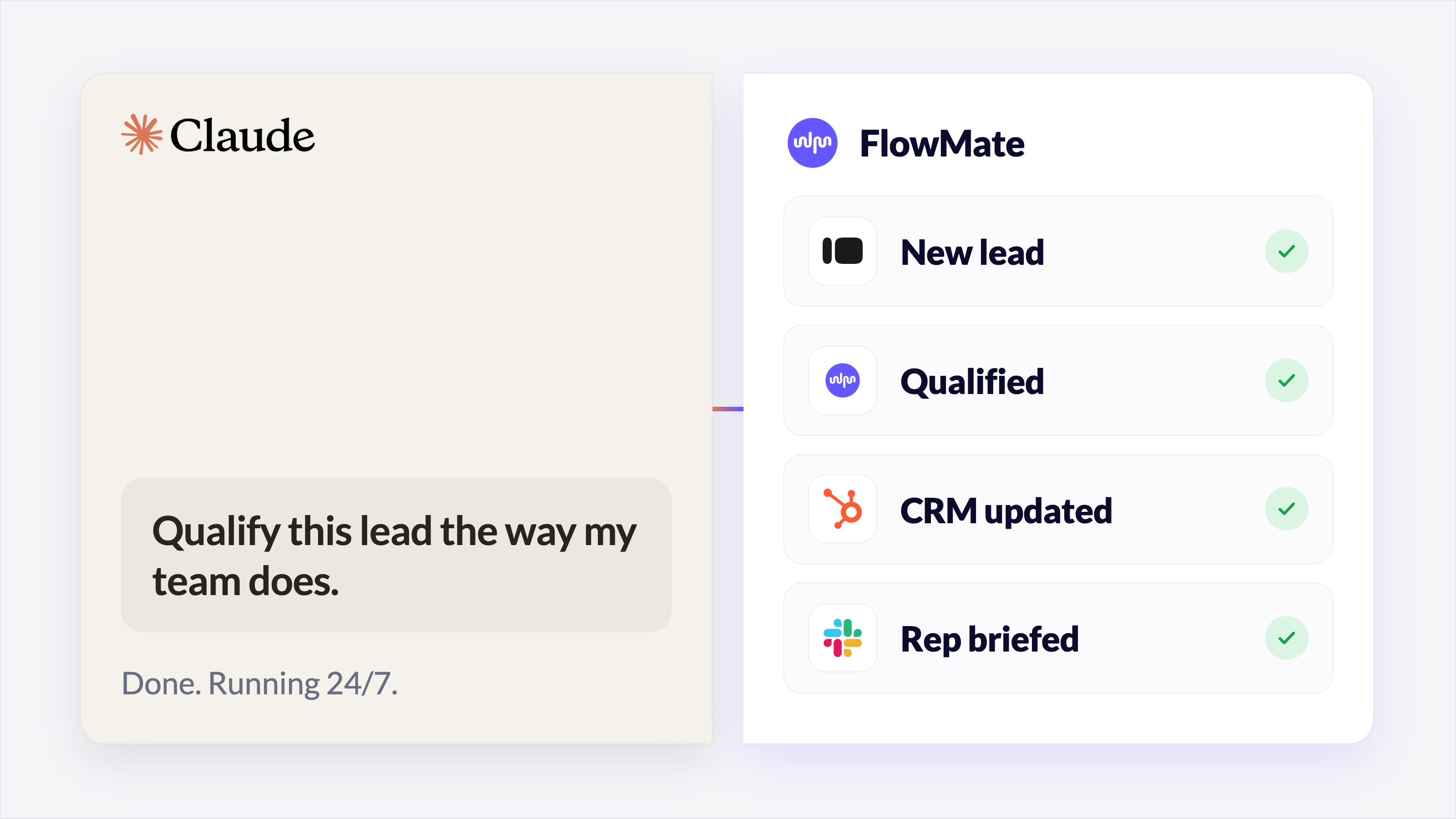
You got Claude to do something well. Maybe it's qualifying inbound leads. Maybe it's drafting the proposal that used to take two hours. Maybe it's triaging support requests before you even open your inbox. You spent real time teaching Claude how the judgment works, the edge cases, the tone, the specific way your company actually makes this call. Now it's fast, it's consistent, and it's good. In every way that matters, this is automation. It already happened.
Then you ask the obvious next question: can this run on its own? Can it fire the moment a new lead comes in, not whenever you remember to open the chat? Can the rest of your team use it, not just you?
That's where it stops.
Claude can already run tasks on a schedule. That covers a lot of ground, a daily summary, a weekly report, a Monday morning check-in. But scheduling is built for things you can put on a clock, once a day, once a week. Lead qualification isn't one of those things. A lead doesn't wait for the next scheduled run. The value is in catching it in near real time, checked as often as every minute, not an hour later, and definitely not tomorrow morning.
And the schedule is only half the problem. Qualifying a lead well isn't one action, it's a Flow: several coordinated steps that only work when they run together. Catch the event. Check whether the person and the company are already known, and enrich what's missing. Run it through the judgment the skill already knows. Write the result back into the CRM. Package it into a briefing the sales rep actually reads before they pick up the phone. That's five coordinated steps across at least three systems, triggered by an event that just happened in real time. A scheduler wasn't built to carry a Flow like that from event to outcome. Neither was a single prompt.
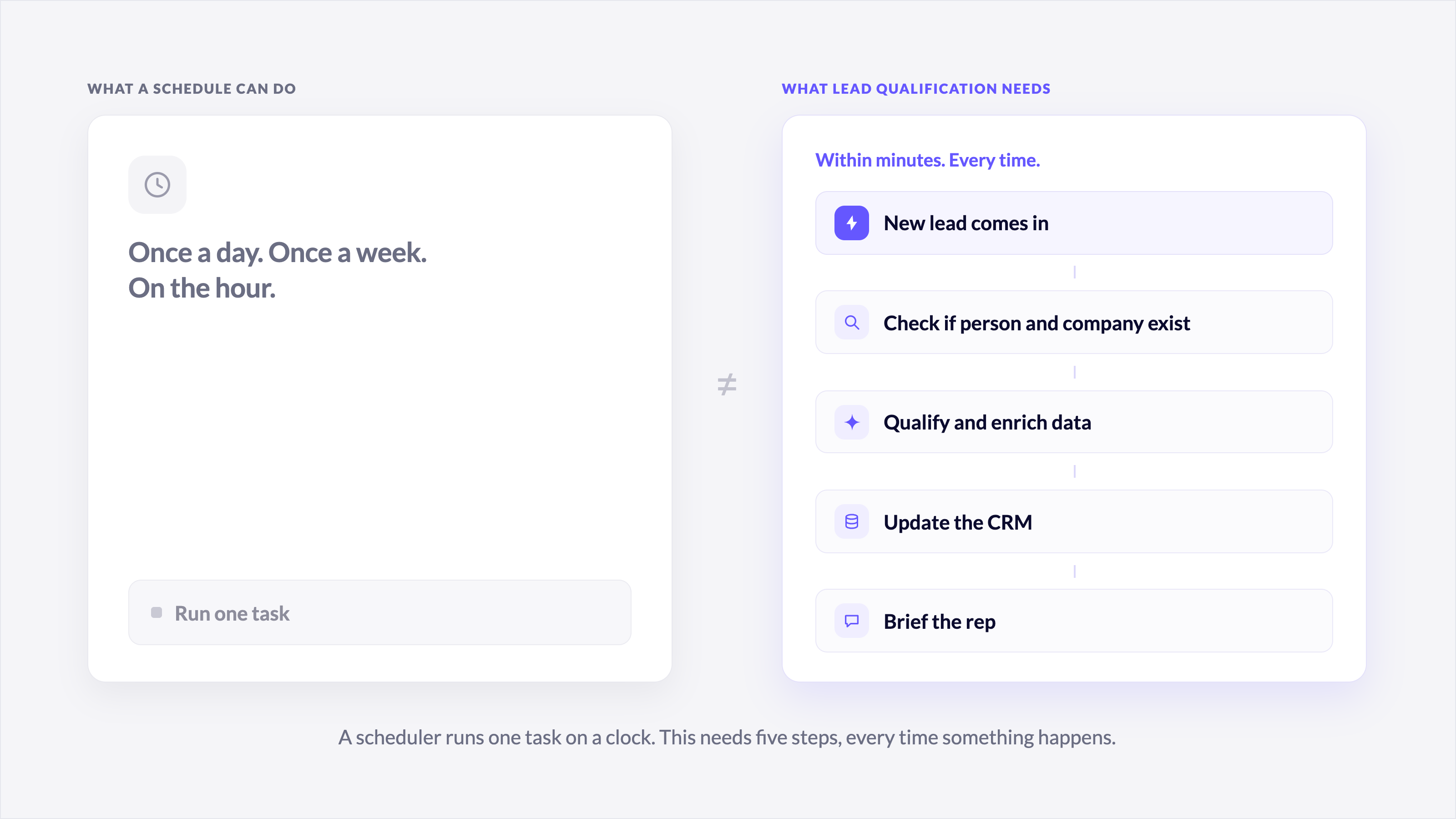
So the skill that worked perfectly in chat hits a wall that has nothing to do with how good it is. It's not that the judgment was wrong. It's that judgment alone was never going to catch a live event and carry it through a Flow like that on its own. That's the exact moment most teams go looking for an automation tool.
Here's what actually happens next. The skill that already understands your business gets left behind, and you start the work over somewhere else. You open a workflow builder and rebuild the logic from scratch: a trigger, a branch, a mapping, a condition, each one translated by hand into a tool that has never seen a single one of your leads. The judgment that took real effort to teach Claude doesn't transfer. It gets reconstructed, imperfectly, in a different language.
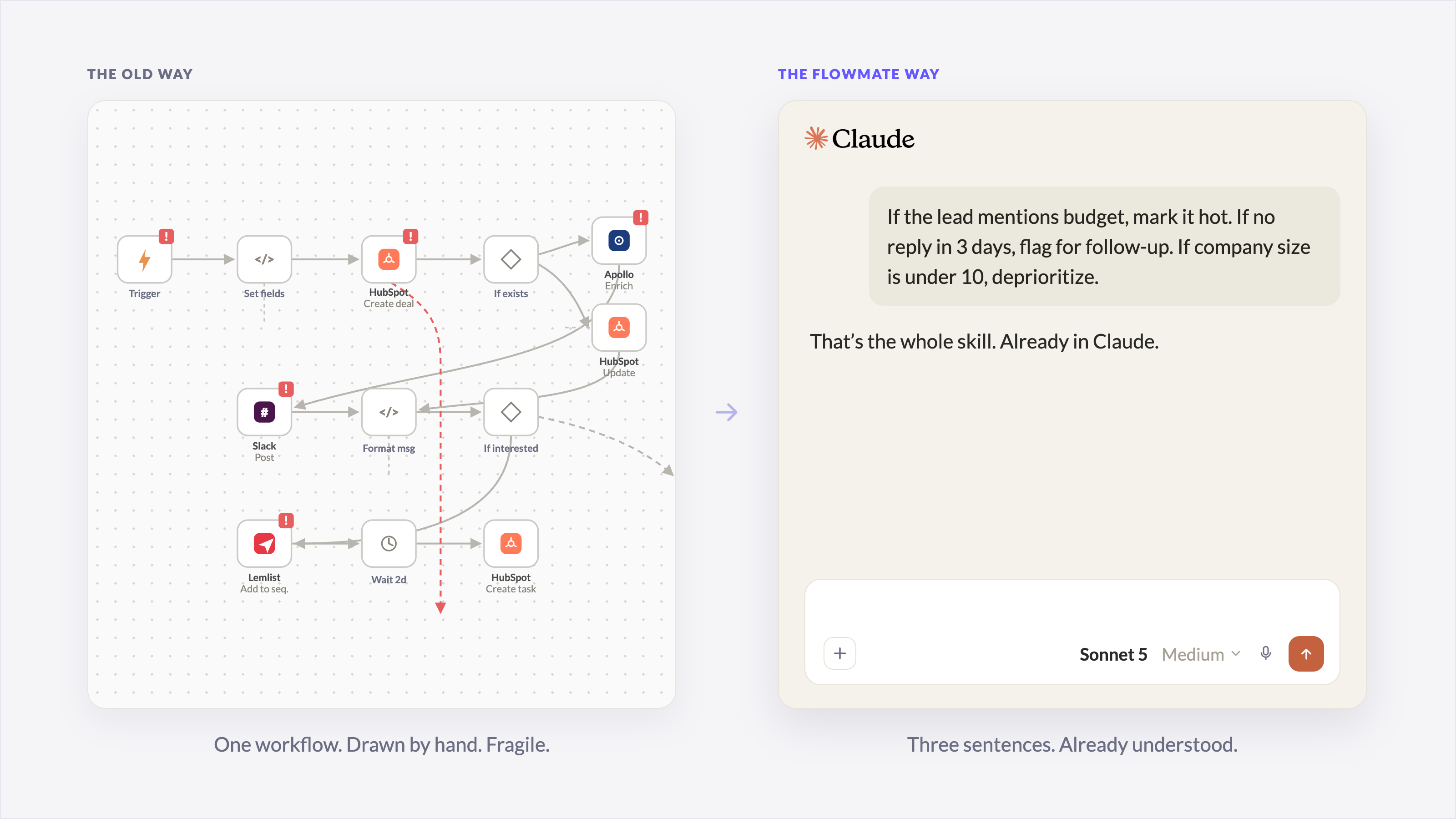
That reconstruction is the rebuild tax. It's not the cost of automating the work. It's the cost of automating it twice, once in Claude, and then again from zero in a tool that starts with none of the context you already built. Paid often enough, the tax gets expensive enough that the second version never gets built at all, and the skill just stays a nice thing one person does manually.
There's also a second loss most teams don't notice right away, and it's worth being precise about it. Some workflow builders, n8n included, now have their own AI agent nodes, so this isn't really about whether the other tool has any reasoning at all anymore. The real gap is what that reasoning starts with. Their agent starts from nothing, it's never seen a single one of your leads, and someone still has to teach it your judgment from scratch, in their interface, in their language. A FlowMate Agent starts from the reasoning your Claude skill already has. Same category of tool, different starting point, and that starting point is the whole rebuild tax in miniature.
None of this is a knock on tools like n8n, Zapier, or Make. They're genuinely good at what they were built for: a fixed trigger, a fixed set of steps, the same output every time, running unattended for as long as you need it to. That's exactly the right tool for a form submission that has to hit your CRM at 3am without fail.
The honest limitation is narrower and more specific: those tools were never built to inherit anything from a skill you already proved out in Claude. They live outside Claude entirely, so from their side, your lead qualification logic doesn't exist until someone types it in again. And that translation isn't a one-time cost. A lead qualification skill in Claude doesn't stay still. The sales team notices a pattern that deserves more weight, or a signal that should matter less, and they just tell Claude to adjust it. It changes the same week, sometimes the same day, by the person who actually owns that judgment. If a live Flow needs to reflect that change too, that's still one more instruction to Claude, in the same conversation. Not a specialist, not a separate tool, not a ticket in a queue.
In n8n or Zapier, the same update means going back to whoever manages the workflow, translating the change into their language, and waiting for it to get made. The real cost isn't setting the workflow up once. It's that every future improvement to the judgment has to be rebuilt again, every time, by someone other than the person who noticed it needed to change.
The real choice isn't between one automation tool and another. It's between rebuilding from zero in a tool that doesn't know your business, or continuing with the one that already does.
There's a second wall that shows up right after the first one, and it's easy to miss because it looks like a smaller problem. Say the lead qualification skill does get automated somehow. It's now wired into exactly one workflow, built for exactly one use case, sitting in exactly one person's setup.
But qualifying a lead well isn't really a personal skill. It's a piece of how the company makes that judgment call, and it's needed in more than one place. The same logic that scores a new inbound lead is also what should run when a lead gets re-engaged after six months quiet, or when a lead comes in through a partner channel instead of the website, or when a rep manually flags an account for re-review. If that judgment only exists inside one rebuilt automation, every one of those other moments needs its own rebuild, or gets skipped entirely.
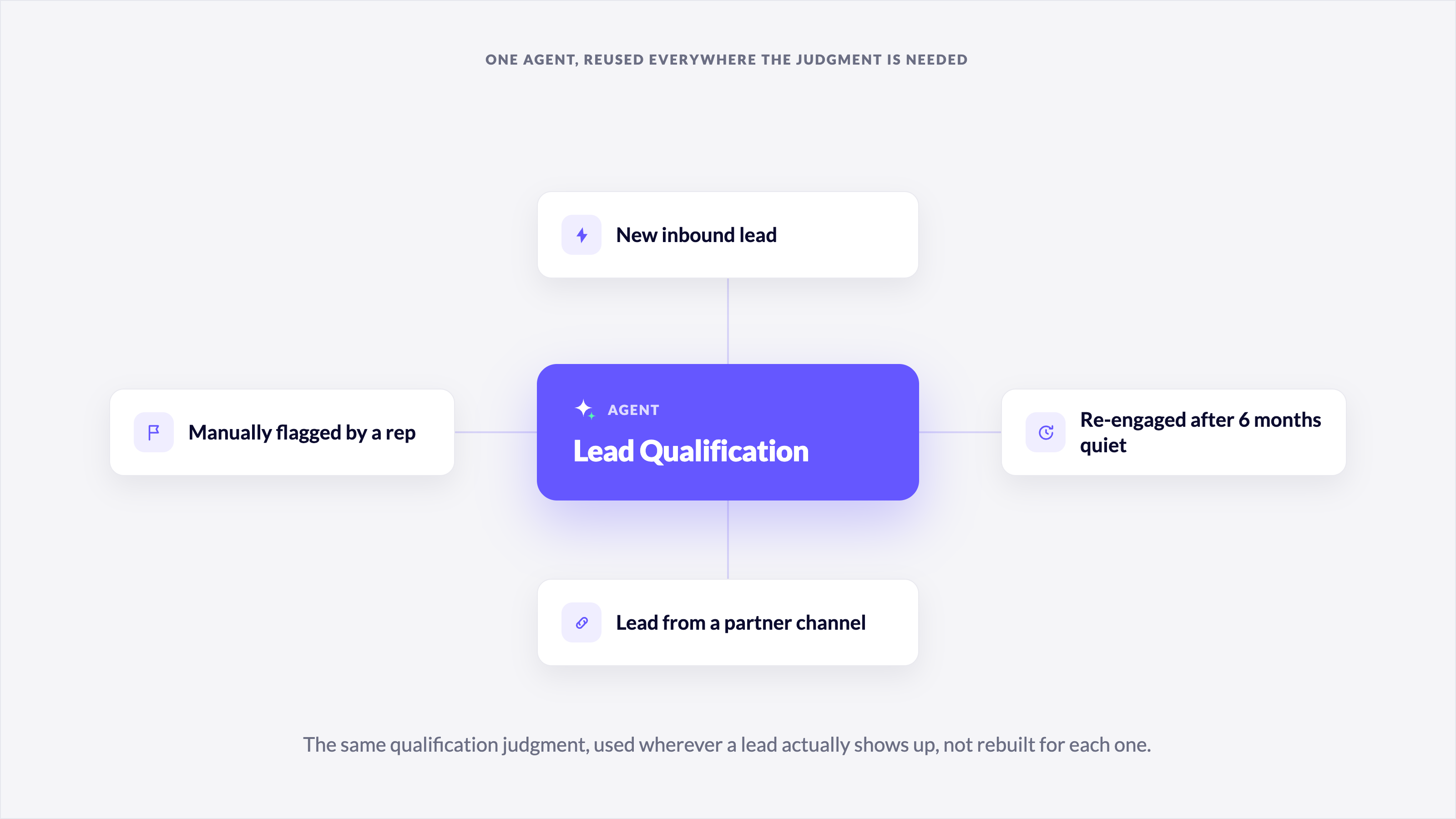
A skill proven in Claude isn't a one-off script. It's reusable judgment. Once it's carried into a FlowMate Agent, that same reasoning can sit inside more than one Flow, wherever the business needs that call made, not rebuilt separately each time. The right question isn't "how do we automate this one workflow," it's "how do we make this judgment available everywhere the business already needs it."
For readers meeting FlowMate for the first time: FlowMate is the automation agent that runs natively inside Claude. A Flow is the automation itself, made up of one or more Agents, the individual steps that do the reasoning inside it. Building one starts with a plain instruction to Claude, something like "build a Flow that uses my lead qualification skill to handle new deals." Claude carries the reasoning your skill already has into a FlowMate Agent, and that Agent becomes part of the Flow.
Worth being precise here: the skill and the Agent are two different things. FlowMate can't reach into Claude and read a skill directly. What it can do is let Claude describe that skill's reasoning once, in one prompt, and build the matching Agent from it, so nothing gets rebuilt in a separate paradigm the way it would in a workflow canvas. If the skill improves later, updating the Agent to match takes the same kind of instruction, one more prompt to Claude, in the same conversation you're already having. If you can already prompt Claude, you already know how to build and maintain a Flow. There's no new tool to learn, no code, and no workflow canvas.
Back to the lead qualification example. The skill already knows how your company scores a lead. You tell Claude to build a Flow around it, and Claude carries that reasoning into a FlowMate Agent, the piece that does the qualifying inside the Flow. From there, the new deal comes in, the Flow catches it within minutes, checks whether the person and company are already known and enriches what's missing, runs it through the same judgment the skill already had, updates the CRM, and drops a ready briefing in front of the sales rep before the call, running on its own from that point on.

The same Flow doesn't have to stay locked into running automatically, either. Say a colleague has a spreadsheet of fifty new contacts from a trade show. Instead of qualifying them one by one, they can just tell Claude, "send this data to the CRM and run it through our lead qualification Flow," the same way they'd invoke any other skill mid-conversation. The Flow does the same work, called on demand this time rather than triggered by an event.
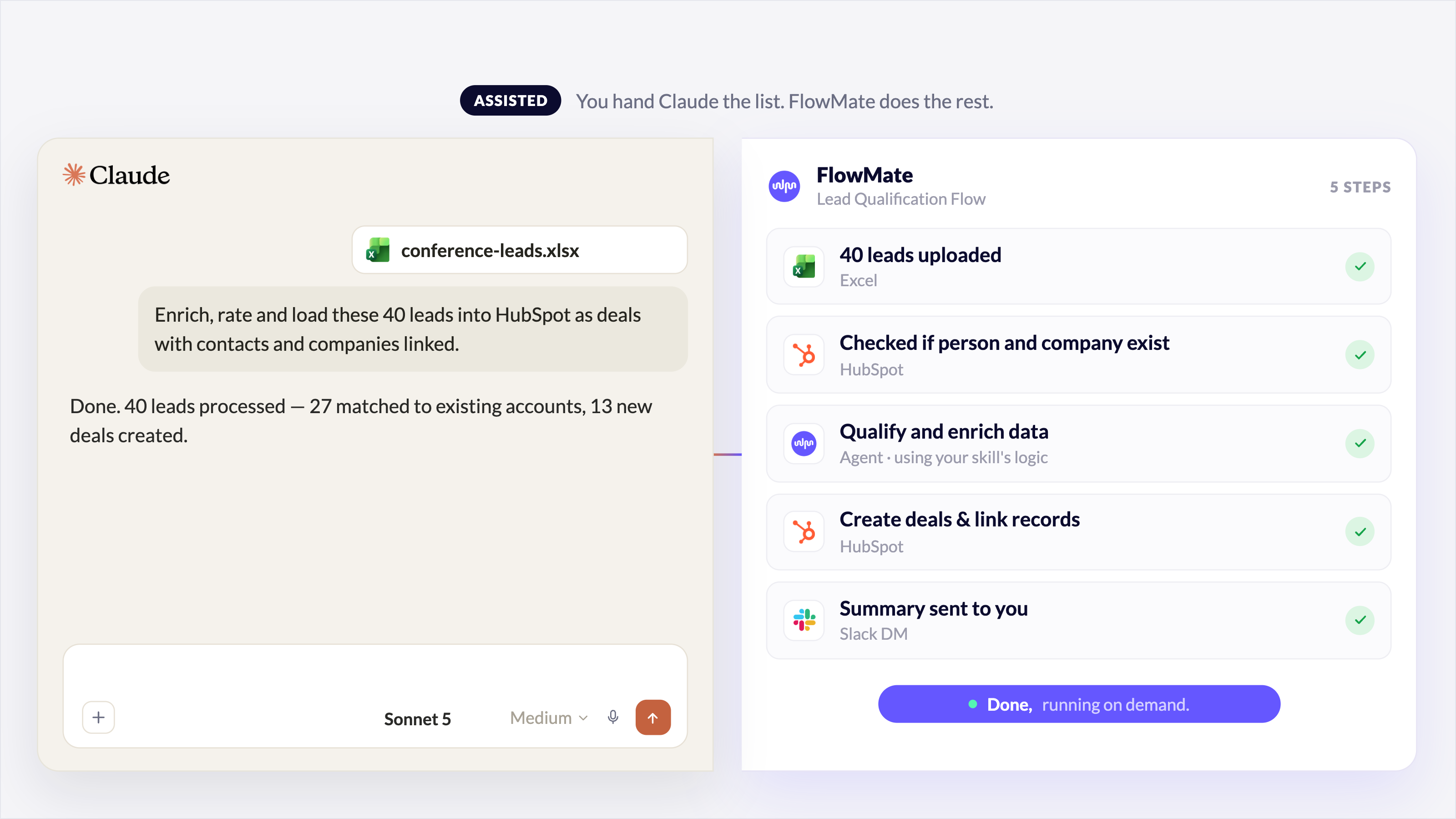
None of this pretends the skill and the Flow are the same object under the hood, they aren't. What changes is what it costs to keep them working together: one instruction to Claude, not a rebuild in a separate tool. And because it's a Flow, not a one-off automation, the same Agent can sit behind the re-engagement case, the partner-channel case, or wherever else the business needs that same call made.
The work you already did teaching Claude how your company operates doesn't get thrown away the moment you want it to run on its own. It becomes the foundation the automation is built on.
If you're already doing this in Claude today, you're not behind, and you're not starting a new evaluation. You're one step from done.
FlowMate has a free plan to start with, no credit card required. See how a skill becomes a Flow →
Isn't this exactly what n8n or Zapier are for? Those tools are excellent at fixed, deterministic workflows, the same trigger, the same steps, every time. The difference is that they start from zero. They have no way to inherit a skill or the context you've already built in Claude, so the logic gets rebuilt by hand. FlowMate starts from what already exists instead of replacing it.
Do I need to rebuild my Claude skill to use FlowMate, and does it stay in sync if the skill changes? You don't rebuild it from scratch. You tell Claude to build a Flow using the skill you already have, and Claude carries that reasoning into a FlowMate Agent in one prompt. The skill and the Agent are technically two separate things, so they don't sync automatically, but keeping them aligned later takes the same kind of instruction: one more prompt to Claude, in the same conversation, not a rebuild in a separate platform.
Can I use a Flow directly in a chat, not just automatically? Yes. Beyond running on its own when an event happens, a Flow can also be called on demand mid-conversation, the same way you'd invoke any other skill, for example asking Claude to run a batch of contacts through your lead qualification Flow instead of doing it manually.
Can this actually run in real time, not just on a schedule? Close to it. Claude's built-in scheduler is designed for tasks you can put on a clock, daily or weekly runs. A Flow checks continuously, as often as every minute, and carries the full multi-step, multi-app sequence through right away, without waiting on the next scheduled run.
Do I need to be technical to set this up? No. If you can describe how your team already makes the judgment call, in plain language, that's the starting point. No workflow canvas, no node graph, no separate platform to learn.
